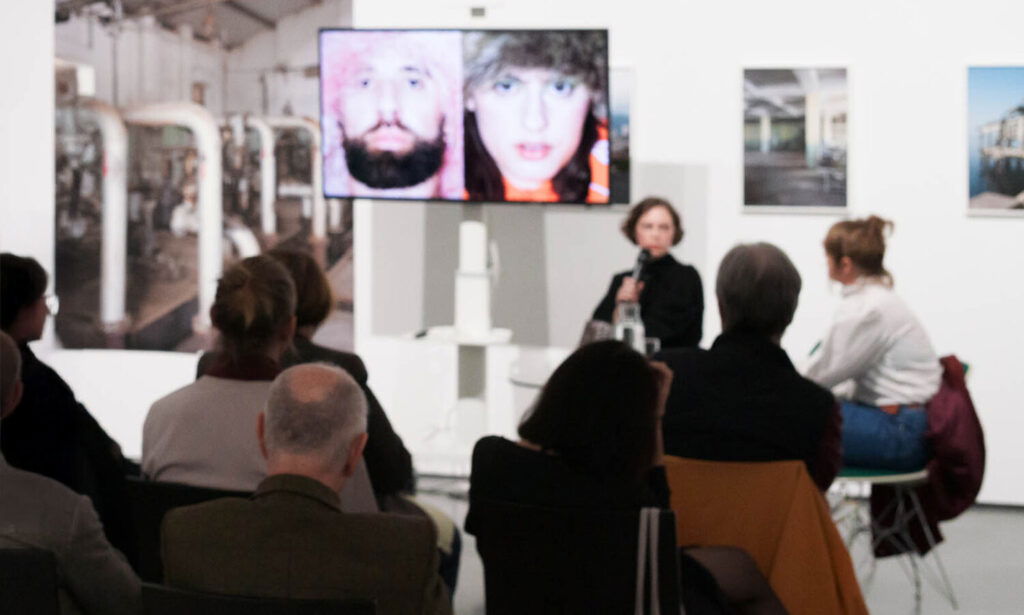
Book Talk
Talking about new books by FOTOHOF>EDITION.
Eric Asamoah »Here, Nowhere Else«
In “Here, Nowhere Else”, Eric Asamoah portrays the boxers of Jamestown, Accra, with a gaze that transforms boxing into a metaphor for life itself: an ongoing struggle of resilience, intimacy, and self-determination. The images balance the personal with the universal, shaped by care, empathy, and openness. Emerging from sustained dialogue with the subjects, the project reflects Asamoah’s artistic stance.
Eric Asamoah, *1999 Linz, Austria; lives and works in Linz, Vienna and Paris; in conversation with Michael Mauracher.
Caroline Heider »Balance Studies«
IT’S A PHOTOGUIDE IT’S A PHOTOBOOK IT’S A PLEASURE IT’S A NEED IT’S PRIVATE IT’S PUBLIC IT’S POLITICAL IT’S CUTE IT’S SOFT IT’S HARD FACTS IT’S EVERYDAY IT’S FOR EVERYONE IT’S BEAUTIFUL IT’S HARDCORE
»Balance Studies. Photography for Everyone« is a conceptual photobook based on the typoskript of Lucia Moholy´s book outline from 1933. Suddenly forced to emigrate, however, she was never able to complete it. Caroline Heider explicitly follows the long tradition of guides in which photographers are advised to master not only the camera and light, but above all composition, i.e. they are to learn how to see. At the same time, as a female writer she breaks away from tradition, as this particular species of instructive literature is authored with a male gaze.
Caroline Heider, *1978 in Munich; lives and works in Vienna; in conversation with Mateusz Dworczyk.
Michael Ponstingl »Social reporting as media spectacle«
Contributions to a History of Photography in Austria, volume 24.
Edited by Monika Faber for Photoinstitut Bonartes, Vienna, and Walter Moser for the Photographic Collection of the Albertina, Vienna
In May 1905, the Urania Adult Education Centre set new standards with its slide show “Through the Viennese Districts of Misery and Crime”: it produced one of the world’s first social reportages to rely on the power of photography. The stirring text by journalist Emil Kläger and the stark photographs by judge Hermann Drawe shed light on the dark side of industrialisation. They documented life in places the middle classes chose to ignore: the sewers, the brick kilns and the tenements. Reactions to this media spectacle ranged from pure sensationalism to deep consternation. With the presentation of photographic prints at the “General Hygiene Exhibition” in 1906 and the publication of the book in 1908, the authors lent additional weight to their cause across various media formats. In 1920, the subject finally found its way onto the cinema screen – featuring a star-studded cast from the Burgtheater.
Michael Ponstingl is a photo historian and curator at the Photoinstitut Bonartes, Vienna; in conversation with Birgit Sattlecker.
Florian Rainer »Tagada«
When the Wiener Riesenrad casts its evening shadows on the Prater, a much smaller but maybe even more significant wheel comes to life: the Tagada. For decades, it has drawn crowds of teenagers looking for a way to escape and find a sense of belonging. Florian Rainer’s series, taken during the summer season of 2020, is a story about this centrifuge and its riders, the teenagers that form its family. The Tagada is a stage for those who want to shine and a meeting point for those with nowhere else to go. It is the only Prater ride that requires skill and physical effort – some learn to ride and some don’t. The riders understand the risks and accept the potential injuries as part of the experience. It is a place where youth, who very often lack other social backing, can gather, a room for transformation, where the shy become confident. The speed, sounds, lights, their friends and the audience allow them to forget their worries, and give them a space to grow up.
Florian Rainer, *1982 in Leoben, Austria; lives and works in Vienna; in conversation with Peter Schreiner.